
Fabric construction entails converting yarns, and sometimes fibers, into a fabric with properties determined by the materials and methods used. Most fabrics are now made through some form of interlacing, such as weaving or knitting. Weaving, which is currently the most common method of fabric production, includes the basic weaves of plain or tabby, twill, and satin, as well as the fancy weaves of pile, Jacquard, dobby, and gauze. Knitted fabrics, which include weft and warp types, raschel and tricot, are rapidly gaining popularity. Net, lace, and braid are examples of interlaced fabrics. Nonwoven fabrics, which include materials made by felting and bonding, are becoming more popular. Laminating processes are also becoming more important, and recent developments include needle weaving and sewing-knitting.
Glossary of Textile Terms
Production of Fabrics
In weaving, lengthwise yarns are referred to as warp, while crosswise yarns are referred to as weft, or filling. The outer edges of most woven fabrics are finished in a way that prevents raveling; these are known as selvages. They run parallel to the warp yarns and run lengthwise.
The type of weave is determined by how the yarns are interlaced. The closeness or looseness of a weave is determined by the yarn count and the number of warp and filling yarns per square inch. The proportion of warp yarns to filling yarns in woven fabrics can also be changed. Some effects are achieved through the use of specific yarns or yarn combinations.
Weaving types
Plain
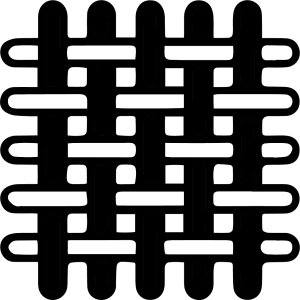
Plain weave is the most basic and widely used textile weave. Each filling yarn is passed over and under each warp yarn, with each row alternating, resulting in a high number of intersections. The weave unit is finished at the end of the second row, when the weft is inserted over and under the opposing set of warps, locking the previous weft in place. With each successive weft yarn inserted, the fabric length increases. When the warp and weft yarns are roughly the same size and quantity, the finished fabric is more balanced and potentially stronger than cloth made of the same kind and number of warp and weft yarns in any other basic weave.
Twill
 Diagonal lines distinguish twill weave. The most basic twill is made by the weft crossing over two warp yarns, then under one, and repeating the sequence in each succeeding shot, but stepping over one warp to the left or right. Twills with more warps than wefts floating on the fabric’s face are known as warp faced, while those with more wefts are known as weft faced. The twill angle can also change.
Twills can be varied by changing the relative number of warps and wefts in each repeat (2:1, 2:3, 3:1, 6:2, etc.); stepping the repeat in one direction; and breaking the direction of the twill’s diagonals at regular intervals.
Twills have a better drape than plain weaves made from the same yarn because twills have fewer interlacings.
Satin

Although satin-weave drafts appear to be similar to twill drafts, satin weave lacks the regular step in each successive weft that twills have. As a result, there is no strong diagonal line, and the fabric has a smooth faced, unbroken surface made up of long floating warp yarns. Each complete weave repeat of a true satin must have at least five warp and weft yarns, requiring at least five harnesses. Because of the limited number of interlacings, the weaver can use a disproportionately large number of warp yarns, resulting in a heavy textured cloth that can be arranged in smooth, shadowed folds.
Textile Fibers
Animal Fibers
Silk
Silk descrption
Wool
Wool description
Plant Fibers
Cotton
Cotton description
Linen
Linen description
Jute
Jute description
Synthetic fibres
Viscose rayon
Viscose rayon description
Polyester
Polyester description
Acrylic
Acrylic description
Polypropylene
Polypropylene description
Polyolefin
Polyolefin description